EK7 Game APK Download: Storage and System Requirements for Android
EK7 Game APK Download: Storage and System Requirements for Android
Android mobile gaming landscapes demand proper technical preparations before initializing any application setup package. Ensuring that individual smartphones possess compatible operating hardware architecture configurations prevents installation failures and application performance lagging. This comprehensive optimization breakdown details structural specifications, background execution criteria, and memory allocation requirements necessary to deploy EK7 Game successfully.
Technical Specifications Matrix
Hardware configurations must align with specific operational metrics to achieve fluid performance markers during active user gameplay. Reviewing basic parameters layout before triggering file distribution channels saves configuration time and guarantees stability.
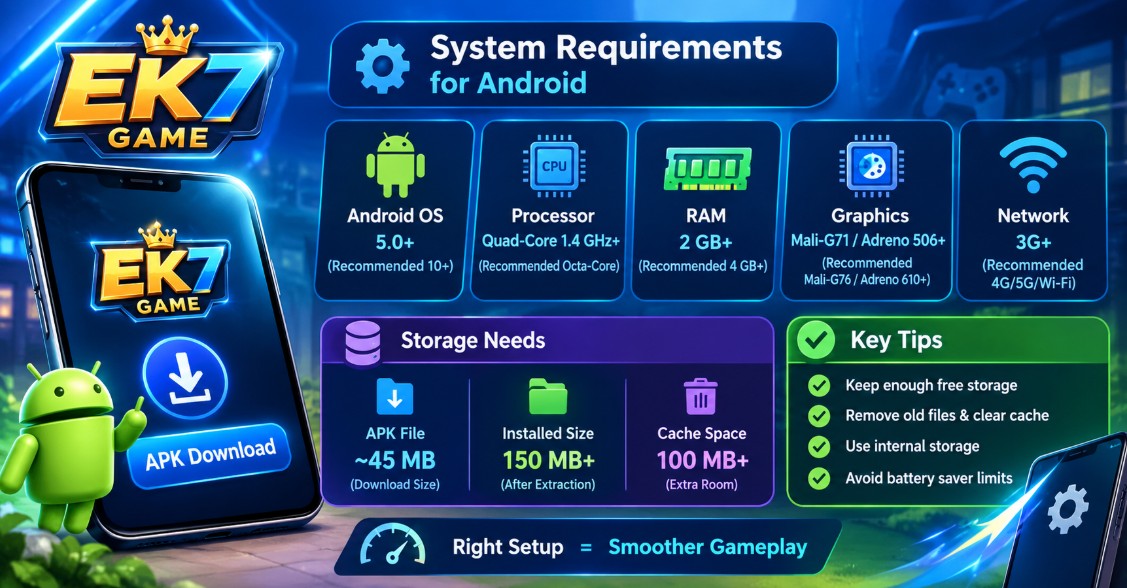
| Hardware Component | Minimum System Requirement | Recommended Configuration |
|---|---|---|
| Operating System | Android 5.0 (Lollipop) | Android 10.0 or Higher |
| Processor Type | Quad-Core 1.4 GHz Silicon | Octa-Core 2.0 GHz+ Architecture |
| System RAM | 2 GB Operational Memory | 4 GB+ Temporary Memory Buffer |
| Graphics Core | Mali-G71 / Adreno 506 | Mali-G76 / Adreno 610 or Better |
| Network Support | Stable 3G Connection | High-Speed 4G / 5G / Wi-Fi |
Memory Allocation and Local Storage Boundaries
Storage limitations cause widespread installation errors across modern Android operating systems. Managing localized directory footprints ensures background installation scripts finish without throwing file generation faults.
Direct Archive Footprint
EK7 Game APK download file package occupies roughly 45 MB of network storage during standard compression transfers. Downloading compressed installation structures requires minimal network bandwidth, making data allocation consumption minor for mobile users. Archived file sizes fluctuate marginally depending on localized regional package variants distributed on internet nodes.
Unpacked Installation Expansion
Unpacking core software builds triggers data extraction protocols that expand directory requirements inside your mobile disk space. Safe directory management plans require at least 150 MB of unallocated internal smartphone storage space to house extracted layout configurations and user interface skins. Operating installations too close to maximum internal space limitations causes write-errors during ongoing data asset logging.
Cache Allocation Guidelines
Online casual games read temporary configuration indexes continually during network synchronization pipelines. Cache files grow organically during active play, occupying additional temporary storage fragments within internal phone memories. Allocating an extra 100 MB of clear room handles incremental operational logs easily, preventing game configurations from crashing unexpectedly due to full local system spaces.
Android Operating System Versions Compatibility
Backward software compatibility bridges differences between entry-level phones and current market flagships. Deploying scalable software frameworks ensures widespread access across legacy operating environments.
- Legacy Systems (Android 5.0 to 7.1): EK7 Game operates reliably on older software builds by using legacy rendering pathways. Users running these devices might observe slightly reduced visual animation smoothness, though underlying application modules perform functions correctly.
- Mainstream Versions (Android 8.0 to 11.0): System stability parameters peak within these specific middleware configurations. Background tasks execute efficiently, and resource scheduling managers route appropriate processor power to active operational threads.
- Modern Frameworks (Android 12.0 and Up): Advanced security configurations require explicit directory authorization during installation execution sequences. Current operational updates synchronize natively with high refresh rate screens, resulting in responsive visual interface tracking.
Processor Performance and Graphics Capabilities
Central processing units handle operational loops, artificial intelligence tracking elements, and user data calculations simultaneously. Balancing compute loads keeps application modules running synchronously without causing frame drop rates.
Compute Core Allocations
Multi-threaded processor setups delegate individual background micro-tasks to low-power cores while prioritizing high-capacity units for primary application operations. Quad-core setups provide sufficient structural foundation to handle underlying tasks without triggering severe heating spikes. Octa-core configurations optimize power efficiency, scaling clock frequencies upward only during complex menu transitions or network update periods.
Image Rendering Engines
Graphics microchips manage resolution scaling parameters and pixel processing pipelines to ensure stable performance metrics on various display layouts. Entry-level display controllers process menu textures and asset sheets effectively over standard rendering frameworks. High-end display cores optimize pixel pipeline efficiency, meaning devices consume less battery wattage while refreshing active layout coordinates.
Temporary RAM Management Protocols
Random access memory functions as direct temporary workspaces for application configurations while task modules process active instruction lists. Insufficient operational memory forces background processes to close down abruptly.
- 2 GB Allocation Environments: Closing unneeded browser tabs and muting resource-heavy messaging platforms helps stabilize runtime conditions. Keeping background structures clear provides maximum operational memory directly to your gaming instance.
- 4 GB and Greater Environments: Multi-tasking structures run concurrently without affecting primary software operations. System memory reserves manage assets smoothly, allowing swift switching between system utilities and platform modules without reloading core databases.
Network Connection Requirements for Casual Categories
Online casual gaming formats rely on consistent server communications to refresh platform dashboards and sync data attributes. Interrupted data flows cause loading freezes or communication sync timeouts.
Connection Speed Baselines
Standard data transmission rates of 1 Mbps deliver enough speed to process core server queries cleanly. High download metrics are unnecessary since lightweight text structures handle ongoing data sync requirements. Network consistency outranks sheer throughput speed when maintaining open channels with remote file servers.
Latency Management Indicators
High ping values disrupt ongoing server responses, leading to layout refresh lags during interface usage. Wi-Fi connections or stable 4G network nodes minimize communication packet loss indexes. Selecting local cellular configurations with low ping scores maintains steady background performance indicators across open platform windows.
Storage Safety and Optimization Recommendations
Maintaining clean device files avoids standard software conflicts during external archive management processes. Following automated diagnostic cleaning habits guarantees error-free installation environments.
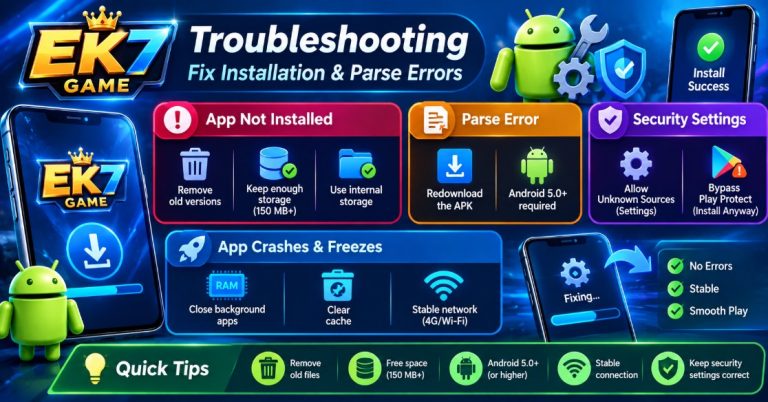
- Remove Older Packages: Delete obsolete archived files or outdated installation frameworks from target download directories before opening new packages.
- Clear App Cache Files: Access internal device storage settings periodically to erase temporary cache files built up from legacy utilities.
- Utilize Internal Storage: Install application components onto primary internal storage directories rather than external memory cards to avoid slower memory reading intervals.
- Monitor Power Settings: Disable extreme battery-saver restrictions that artificially limit processor frequencies and restrict background network data transfers.
Final Configuration Summary
Confirming system specifications before starting your EK7 Game APK download protects hardware stability and delivers smooth usage records. Keeping device directories clean, maintaining minimum Android 5.0 software environments, and preserving unallocated storage room completely avoids standard parse faults. This optimized framework ensures entry-level smartphones run application configurations comfortably while utilizing minimal resource parameters across all active sessions.